

Pedagogies of Wellbeing in the Primary School
In this blog, stormbreak’s Research and Practice Ambassador, Dr. Vicky Randall, introduces her new book and shares how stormbreak has inspired her to consider a new way of thinking about teaching for and about wellbeing in primary schools.
Stormbreak-Inspired Pedagogy of Wellbeing
In her fifth annual report on Children’s Mental Health Services, the Children's Commissioner, Dame Rachel De Souza, highlighted a sobering reality: the demand on children’s mental health services continues to soar. Approximately 1 in 10 children in England - around one million young people - have been referred to a mental health service. This heightened level of concern and awareness will undoubtedly continue to shape both policy and practice in our schools, intensifying the demand for more, and much needed, specialist mental health provision services.
However, such a dramatic shift in the emotional wellbeing and mental health needs of young people requires more than just an increase in specialist and internal interventions.
It demands a fundamental shift in our daily practices as teachers and educators.
Shifting the Continuum
What I have come to deeply appreciate through working with the team at stormbreak over the last eight years, is that supporting a child’s journey about their mental health is not just about preventing ill health, but about supporting their understanding of mental health more completely. It is as much about our daily, lived interactions as it is about specialist services and clinical support.
It is at this everyday end of the continuum where we, as educators, have immense agency. Our pedagogy and practice can have a profound impact on how children think and feel about themselves and how and where they choose to move.
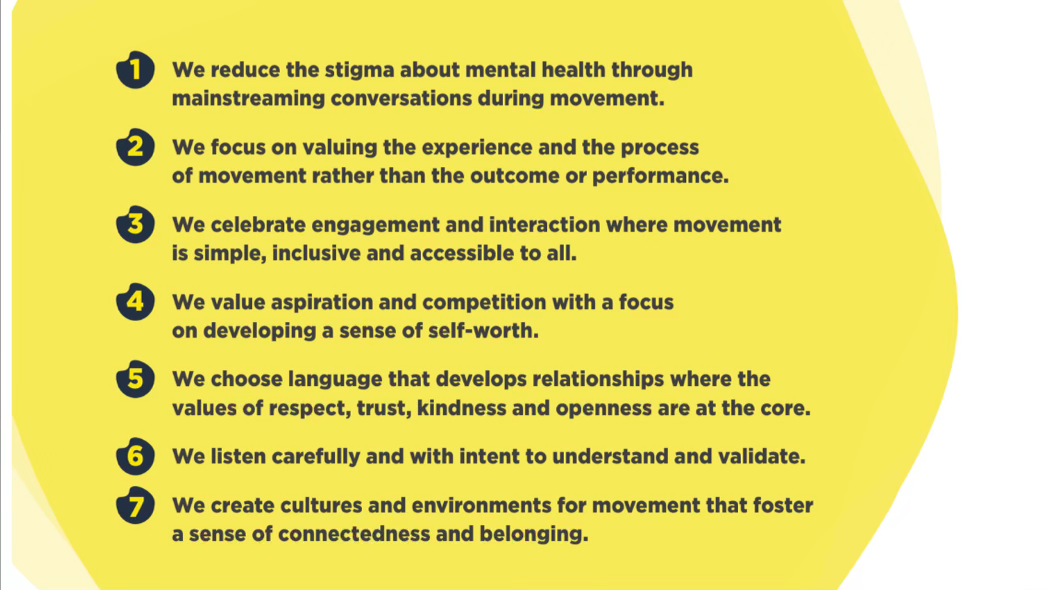
Since the early days developing the stormbreak approach alongside Dr Martin Yelling the core principles of engagement underpinning its mission have remained unwavering. These fundamental principles highlight what it means to be a practitioner who embeds mentally healthy movement within an intentional culture of wellbeing. While attending to each of these principles concurrently is a challenging task for the most experienced educator, I often ask teachers to reflect on one principle they think could make the most impact and bring about the most change in their classrooms.
A Different Way of Thinking
Stormbreak has challenged me to think differently about mental health wellbeing. It has allowed me to articulate a pedagogical practice that recognises our interactions with young people as the most powerful universal tool we possess to help them navigate the complexities of life.
The catalyst for bringing these ideas together into a new book, Pedagogies of Wellbeing in the Primary School, came following a symposium at the British Educational Research Association (BERA) conference. There, members of the stormbreak research and evaluation team presented alongside my Co-Editor, Dr Rhiannon Love, present findings from our respective work in schools, sparking a powerful convergence of ideas. Drawing inspiration from both the Philosophy for Children (P4C) movement and the transformative, movement-based work of stormbreak, we wanted to present a different way of thinking about wellbeing in primary schools - one that can be enacted across the curriculum to enrich the breadth of children's experiences.
Wellbeing as a Pedagogy
Pedagogies of Wellbeing in the Primary School is a text that brings together experts from across educational disciplines, including the humanities, physical education, leadership, psychology, spirituality, philosophy, and inclusion. Together, we present evidence-based, practical strategies showing that wellbeing can be seamlessly integrated into daily life alongside disciplinary subject teaching.
One of our central arguments in the book is that wellbeing should not be seen simply as content to be taught. While curriculum lessons that teaches about emotions and mental health have a crucial and important place in schools (such as the PSHE Foundation for Wellbeing Curriculum), wellbeing is also shaped by how children experience learning and how it is modeled by the adults around them.
Children build their sense of belonging, agency, confidence and self-worth through their everyday interactions with teachers, peers, and other adults across the school day. The opportunities they have to express their views, to be listened to, to ask questions, and to engage with complex ideas all contribute to a child’s overall wellbeing.
Therefore, alongside what we teach, we argue in this book that pedagogy must also matter.
Movement as an Embodied Pedagogy
Some of the innovative frameworks explored in the book directly connect with stormbreak’s aforementioned Principles of Engagement. Specifically, in my chapter Movement as an Embodied Pedagogy, connects to stormbreak’s third principle of engagement: "valuing the experience and the process of movement, rather than the outcome or performance."
I examine the critical role of movement-based pedagogies in supporting children’s emotional wellbeing across many curricular forms. Grounded in research that connects neurobiological and physiological processes with the environments in which children live and move, I look to consider practices that highlight movement’s multifaceted value as a pedagogy.
In doing so, I also challenge a prevailing discourse where movement is purely experienced through sport, competition, or skill acquisition, advocating instead for a more integrated, everyday use of movement to support wider learning. I position movement not as an extracurricular activity, but as a core pedagogical tool - one that can be intentionally embedded to create spaces where children can build emotional resilience and agency.
Aligning closely with the stormbreak approach, the chapter conceptualises movement as a central means to learn about the world and ourselves. I invite educators to create environments that meet children’s internal needs as well as natural propensity they have to move externally, allowing emotional, cognitive, and physical engagement to be experienced in tandem.
Towards a Pedagogy of Wellbeing
The chapters in Pedagogies of Wellbeing in the Primary School highlight an approach that attends not only to what children learn, but to who they are becoming. By viewing wellbeing not as an optional add-on but as intrinsic to the fabric of teaching and part of a whole-school approach, our hope is to empower educators to create inclusive environments where both children and adults can feel valued and can thrive.
We hope this book challenges you to consider:
What does a culture of wellbeing look like in your school context?
And how do you intentionally weave wellbeing into your daily professional practice?
Sharing our thoughts and experiences through Pedagogies of Wellbeing in the Primary School, we hope to provide schools, teachers, and trusted adults with a compelling vision of how this can be achieved.
For practitioners who already adopt the stormbreak approach, our book provides further evidence of the vital role that wellbeing-centered pedagogy plays in creating classrooms where children can think carefully, connect meaningfully with others, and safely navigate the complexities of a modern world.
Pre-order Today: Pedagogies of Wellbeing in the Primary School is available for pre-order on the Emerald website
Dr Vicky Randall, stombreak’s Research and Practice Ambassador
1 July 2026